

Executive Summary
When teams evaluate iorad against Instruqt, they’re often comparing two tools that sound similar on the surface — but solve fundamentally different problems.
Here’s the clean breakdown.
Instruqt is a hands-on lab platform built for spinning up real, disposable sandbox environments — primarily for technical products (developer tools, cloud infrastructure, APIs, Kubernetes, etc.). iorad is an interactive, step-by-step workflow tutorial platform built for teaching repeatable processes across any tool — CRM, LMS, ERP, support systems, internal software, desktop apps, and more.
Simple positioning:
- Instruqt = practice inside a sandbox
- iorad = execute a workflow in real tools
If your goal is to provision temporary cloud environments for developers → labs make sense.
If your goal is to train people how to complete real business workflows → iorad is purpose-built for that.
The Core Difference in Philosophy
Instruqt: Environment-Based Learning
Instruqt creates temporary, isolated environments where learners can run real commands or manipulate real infrastructure safely.
Typical use cases:
- DevRel workshops
- API training
- Kubernetes labs
- Cloud infrastructure demos
- Technical certifications
The environment is the learning surface.
iorad: Workflow-Based Learning
iorad creates directed, linear tutorials that guide learners step-by-step through real processes inside the tools they already use.
Typical use cases:
- Customer education
- Sales enablement
- Internal onboarding
- Process documentation
- SOP training
- Cross-system workflows
The workflow is the learning surface.
Technical Lift & Build Complexity
Instruqt: Higher Technical Investment
Building labs typically requires:
- Markdown for instructions
- YAML configuration files
- CLI workflows
- Setup/check/cleanup scripts (Bash, Python, etc.)
- Infrastructure provisioning knowledge
- Engineering or DevRel involvement
Here’s an example webinar explaining how to build a lab:
(36-minute walkthrough just to explain lab setup)
This isn’t accidental: labs require infrastructure orchestration. That means:
- Technical skillset required
- Engineering involvement
- Maintenance overhead
- Dev/infra cost awareness
iorad: Low Lift, Built for SMEs
iorad tutorials can be created by:
- Enablement teams
- Customer education teams
- Operations
- SMEs
- CS teams
- Sales enablement leaders
No coding.
No YAML.
No scripts.
No infrastructure.
You simply capture your screen and the workflow builds automatically.
Example tutorial created in seconds:
Here's an interactive tutorial
This difference alone often determines the right tool.
Proprietary Software vs. Real-World Tech Stack
Important Distinction
Instruqt works best when:
You own the proprietary technology being trained on.
Why?
Because labs are designed to spin up controlled environments tied to your product.
They are not designed to:
- Spin up Salesforce instances
- Spin up HubSpot
- Spin up Zendesk
- Spin up your CRM
- Spin up internal systems
- Spin up cross-tool business processes
Labs are built for:
- Technical product simulation
- Terminal or infra-based training
- Developer experiences
iorad works across any system
iorad works on:
- Any browser-based software
- Any CRM
- Any LMS
- Any ERP
- Desktop apps
- Internal tools
- Cross-system workflows
It does not require ownership of the underlying codebase.
If your training spans:
Salesforce → Zendesk → Internal BI → Slack → Email → Spreadsheet
iorad handles it seamlessly.
Labs do not.
Speed of Access & Learner Experience
Instruqt
Labs require environment provisioning.
Even with optimizations like background loading, labs inherently:
- Spin up infrastructure
- Create disposable environments
- Launch unique sessions
That introduces:
- Wait time before launch
- Per-session resource consumption
- Infrastructure dependency
- Consumption-based pricing
Each launch consumes resources.
iorad
Tutorials:
- Load instantly
- Can be replayed unlimited times
- Do not spin up environments
- Do not incur usage-based infrastructure cost
If a learner needs a 60-second refresher — they get it instantly.
There is no environment boot time.
Cost Model Dynamics
Instruqt
- Consumption-based pricing
- Infrastructure-backed
- Per-launch resource draw
- Designed for technical workshop economics
iorad
- Content asset model
- Create once, reuse infinitely
- Unlimited replays
- No infrastructure spin-up per learner
For customer education at scale, this difference becomes material.
Customer Education Reality Check
Most customer education teams need:
- Repeatable workflows
- Feature adoption guidance
- Cross-tool process clarity
- Help center augmentation
- LMS embedding
- Sales enablement reinforcement
- Internal process documentation
They do NOT need:
- Ephemeral Kubernetes clusters
- Disposable cloud instances
- CLI-based environment orchestration
Labs are powerful — but overkill for most customer education use cases.
When Instruqt Is the Right Choice
Choose Instruqt if:
- Your product is highly technical
- Learners must run real commands
- You need disposable sandbox environments
- You’re training developers or DevOps engineers
- The environment itself is the product
When iorad Is the Right Choice
Choose iorad if:
- You need scalable customer education
- You train across multiple systems
- You document business processes
- You support enablement teams
- SMEs need to create content quickly
- You need instant access training
- You want to reduce support tickets
- You want to shorten time-to-value
Hybrid Approach (Often the Smartest Path)
Some companies use both:
- Instruqt → for sandbox developer practice
- iorad → for guided workflows and real-world execution paths
For example:
- Lab teaches how infrastructure behaves.
- iorad teaches how to execute workflows inside the real customer stack.
Different layers.
Different purposes.
The Bottom Line
Instruqt and iorad are not direct substitutes.
They serve different layers of the learning stack:
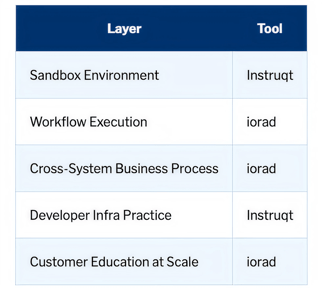
If you need a sandbox → choose a lab.
If you need a workflow → choose iorad.
Try both. Then decide.
You don’t have to guess. Build the same tutorial in both tools and see which one feels like a better fit for your team.