

For years, enablement and L&D teams have battled the gap between training completion and actual adoption. On paper, the training is “delivered.” In reality, workflows still break down, sellers still escalate basic questions, and new systems take months to stick.
The reason is simple:
Most corporate training relies on passive formats, while learning science overwhelmingly shows that active, experiential methods produce dramatically higher retention.
The Learning Pyramid (page 1 of your PDF) illustrates this clearly. It suggests that learners retain:
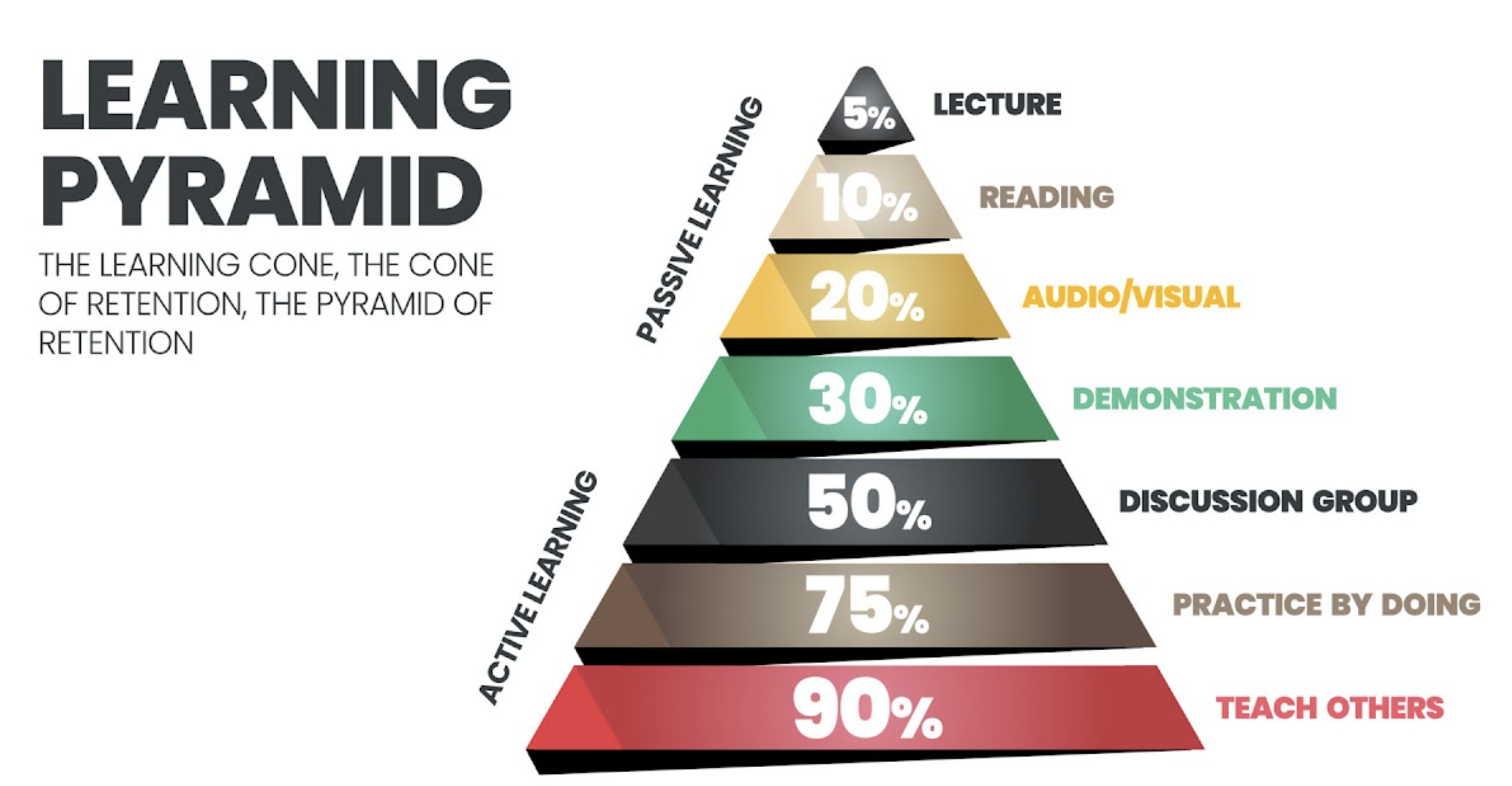
While these specific percentages have been debated in academic circles (see the National Training Laboratory debate below), the underlying principle is strongly supported by decades of research:
Learning becomes durable and transferrable when learners actively do something with the information.
This is the foundation of experiential learning, active learning, cognitive science, and adult learning theory.
Let’s break it down with research-backed evidence.
Why Passive Training Underperforms: What the Research Actually Says
1. Adults don’t learn by absorbing — they learn by doing
Malcolm Knowles, the father of adult learning theory (Andragogy), argued that adults learn best when:
- The learning is self-directed
- It's immediately applicable
- It connects to real-life tasks
- It involves active participation
Source:
Knowles, M. (1973). The Adult Learner.
https://infed.org/mobi/malcolm-knowles-informal-adult-education-self-direction/
This mirrors the lower tiers of the Learning Pyramid where practice, discussion, and teaching dominate.
2. Active learning significantly improves outcomes
A landmark meta-analysis of 225 studies in STEM education (Freeman et al., 2014) found:
- Active learning increases exam performance by 6 percent
- Students in passive lecture environments are 1.5 times more likely to fail
Source:
“Active Learning Across Disciplines.” PNAS.
https://www.pnas.org/doi/10.1073/pnas.1319030111
Why does this matter for enterprise training?
Because the same cognitive mechanisms apply. When employees only watch or read, the learning never makes it into long-term memory.
3. Cognitive Load Theory: Too much information = zero behavior change
John Sweller’s Cognitive Load Theory shows that the brain can’t absorb more than a few elements at once. Dense wiki pages, 40-minute videos, and long PDFs overwhelm working memory.
Source:
Sweller, J. (1988). “Cognitive Load During Problem Solving.” Cognitive Science.
https://onlinelibrary.wiley.com/doi/10.1207/s15516709cog1202_4
Interactive tutorials reduce cognitive load by:
- Breaking down workflows step-by-step
- Sequencing information
- Allowing learners to focus on one action at a time
This dramatically reduces complexity and increases retention.
4. Mayer’s Multimedia Learning Theory: multimodality improves retention
Richard Mayer’s research proves that learning improves when information is delivered through:
- Visuals + narration
- Layered steps
- Interactive elements
His multimedia principles show that people learn better from words and pictures than from text alone.
Source:
Mayer, R. (2009). Multimedia Learning.
https://doi.org/10.1017/CBO9780511811678
This supports why interactive, multimodal tutorials outperform static documents.
5. Chi’s ICAP Framework: More interaction = deeper learning
Professor Michelene Chi’s ICAP model categorizes learning behaviors from least to most effective:
- Passive (watching, reading)
- Active (clicking, highlighting)
- Constructive (explaining, writing)
- Interactive (dialogue, collaboration, guided practice)
Source:
Chi & Wylie (2014). “The ICAP Framework.” Educational Psychologist.
https://www.tandfonline.com/doi/abs/10.1080/00461520.2014.965823
Interactive tutorials land in the active-to-interactive zone — where durable learning happens.
Why Interactive Tutorials Fit the Learning Pyramid
Even though the precise percentages in the pyramid have been debated (here’s a good overview: https://www.washingtonpost.com/news/answer-sheet/wp/2013/10/31/that-learning-pyramid-youve-seen-maybe-isnt-based-on-actual-science/
), the hierarchy aligns with every major learning theory:
- Higher retention comes from more active engagement
- Lower retention comes from passive consumption
Interactive tutorials are one of the few digital formats that sit in the high-retention range because they allow learners to:
- Observe the workflow (demonstration)
- Practice in a simulation
- Apply in the live system
- Create tutorials (teaching others)
This naturally matches the bottom half of the Learning Pyramid.
Bringing the Learner Adoption Journey Into It
In your Learner Adoption Journey framework, learners move through:
- Exposure
- Orientation
- Guided Doing
- Independent Execution
- Mastery / Teaching
This mirrors:
- Kolb’s Experiential Learning Cycle
(Concrete experience → Reflective observation → Abstract conceptualization → Active experimentation)
https://www.simplypsychology.org/kolb-learning-styles.html - Merrill’s First Principles of Instruction
(Demonstration → Application → Integration)
https://mdavidmerrill.com/Papers/firstprinciplesbymerrill.pdf
Interactive tutorials fit naturally into the guided doing and independent execution phases — where nearly every model says the real behavior change happens.
Let’s Add Some Hard Metrics
Active practice improves retention by 2–3x
National Institutes of Health research shows active participation dramatically improves both long-term retention and the ability to recall steps under pressure.
Source:
https://pubmed.ncbi.nlm.nih.gov/28009746/
Hands-on simulation reduces time to competence by 40–60 percent
ATD (Association for Talent Development) studies show structured practice environments cut onboarding time significantly.
Source:
ATD Research Report: 2019 State of the Industry
https://www.td.org/research-reports/soi-2019
Learners forget 70 percent of passive content within 24 hours
Ebbinghaus’ Forgetting Curve principle.
https://fs.blog/ebbinghaus-forgetting-curve/
Interactive walkthroughs reduce errors by up to 80 percent
Gartner Digital Adoption research highlights that guided workflows dramatically cut user mistakes in complex systems.
Source:
Gartner, Improve Employee Proficiency with Digital Adoption Solutions
https://www.gartner.com/en/documents/3986982
None of these numbers require referencing iorad specifically — they support the category of interactive, guided, multimodal learning.
Why the Industry Is Shifting Toward Multimodality
Learning science, adult learning theory, cognitive psychology, and digital adoption research all agree:
- People don’t learn from reading alone
- Videos don’t create competence
- Demonstration without practice doesn’t transfer
- Context matters
- Doing beats watching
- And teaching others beats everything
This is why the industry is moving toward:
- Interactive simulations
- Step-by-step guided workflows
- Multi-format learning assets
- Practice-first onboarding
- In-app support rather than out-of-app reference material
And yes — this is why companies in our space (iorad included, but not exclusively) focus on multimodal, interactive learning experiences.
It’s not because it’s trendy.
It’s because learning science makes it unavoidable.